Why Stretching and Core Strength Matter More Than You Think (Especially After 40)
Nobody tells you that the injuries slowing people down in their fifties and sixties rarely come out of nowhere. They’ve been building quietly for years — in tight hips, a weak core, and the stretching routine that got dropped somewhere around the time life got busy.
Here’s what the evidence actually says, and what it means for anyone who trains regularly and wants to still be training at 70.
The flexibility problem — and why it starts earlier than you think
Flexibility declines with age. That’s not news. But the rate and consequences are worse than most people realise.
According to Harvard Medical School, men’s flexibility often drops sharply around age 70 — with the shoulders, hips, spine and knees losing the most range of motion. The result is that everyday movements become progressively harder: reaching overhead, squatting, twisting, bending. Not dramatic injuries — just a slow, creeping reduction in what your body can do comfortably.
The mechanism is straightforward. As Harvard Health explains, muscles shorten and become tight when they’re not regularly stretched. When you then call on those shortened muscles for activity, they’re weak and unable to extend fully — which increases the risk of joint pain, strains and muscle damage.
The practical upshot: the tight hamstrings, restricted hips and stiff thoracic spine that feel like minor inconveniences in your forties become genuine functional limitations in your sixties.
The core strength argument — and why it’s not about aesthetics
Forget the six-pack conversation. Core strength — the deep stabilising muscles of your trunk, not just the superficial ones that show up in photographs — is one of the most important investments you can make in your long-term physical function.
According to Harvard Medical School, a strong core does more than improve your shape. It supports better posture, balance and stability, acting as the central link between your upper and lower body for everyday movements — bending, reaching, standing upright. Crucially, strengthening these muscles helps prevent falls and injuries, especially as you age.
The fall statistics are stark. Harvard Health reports that more than one in four adults over 65 fall each year, with around 20% of those falls resulting in a broken bone or head injury. Falls are the number one cause of injury-related death in that age group. The three physical conditions that most contribute to falls, according to physical therapists at Harvard-affiliated Spaulding Rehabilitation Hospital, are weak stabiliser muscles, poor core strength and balance issues.
You don’t have to wait until you’re 65 for this to become relevant. The trajectory begins in your forties. The training decisions you make now directly affect how you move — and how safely — in your sixties and seventies.
What actually works
Static stretching after training, not before.
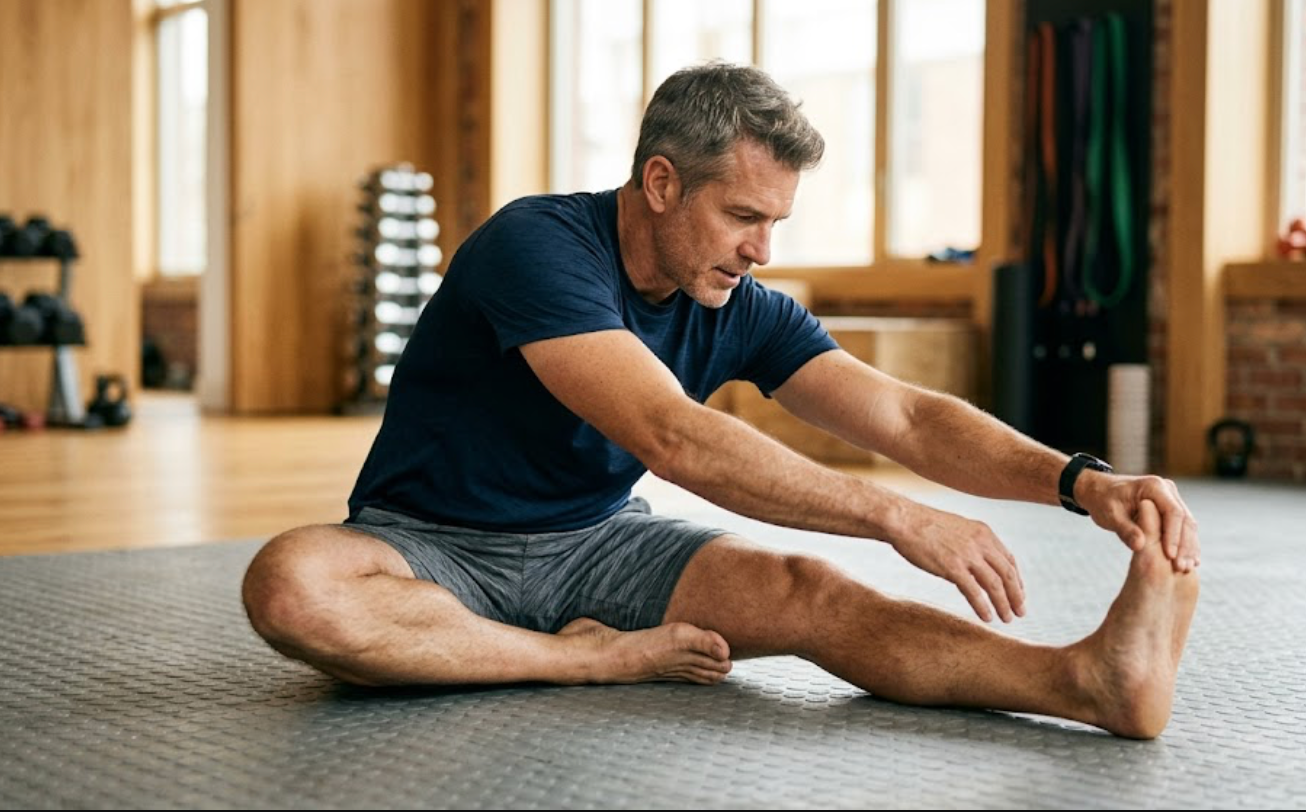
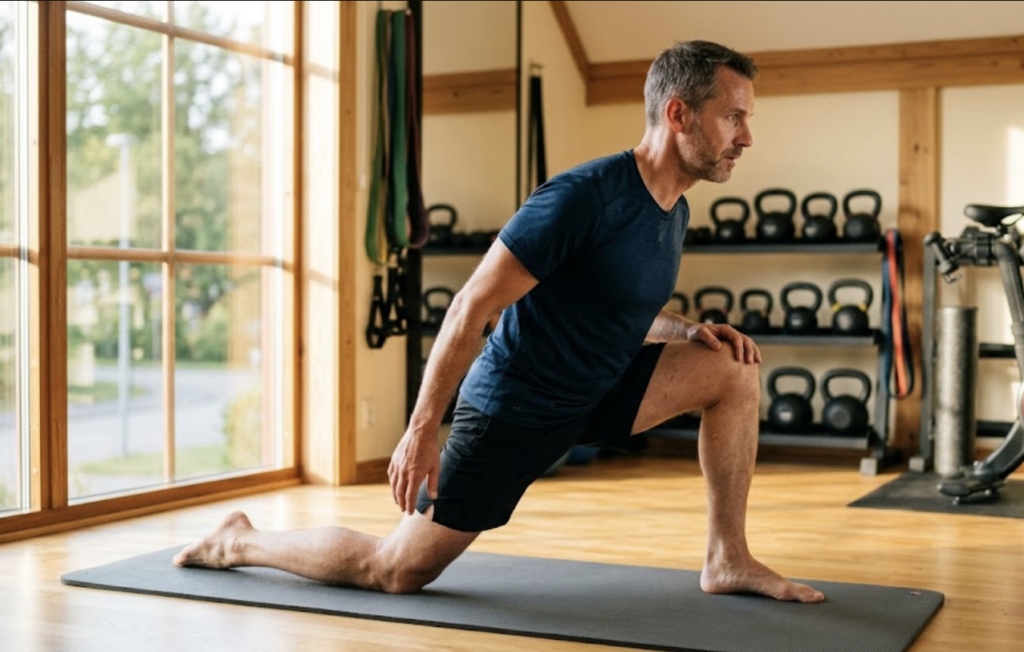
Harvard Health is clear on this: it’s important to stretch after a workout, not before. Save static stretching — holding a position for 30 to 60 seconds — for after your session when muscles are warm. The American College of Sports Medicine, cited by Harvard, recommends flexibility exercises for all major muscle groups at least two to three times a week, spending a total of 60 seconds on each stretch.
The areas that matter most for men who train systematically: hip flexors, hamstrings, thoracic spine, calves and shoulders. These are the areas that tighten fastest with consistent training and tightest with prolonged sitting.
Dynamic stretching before training.
Leg swings, hip circles, thoracic rotations. Moving actively through your range of motion before training prepares joints and muscles without the drawbacks of static stretching as a warm-up.
Core work that actually trains stability.
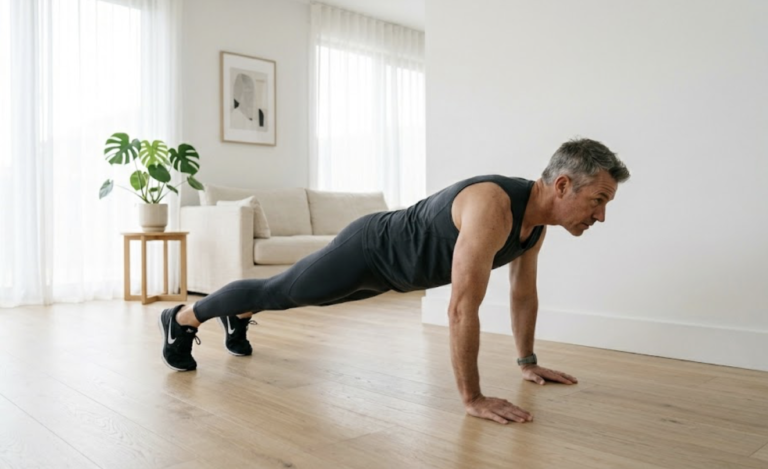
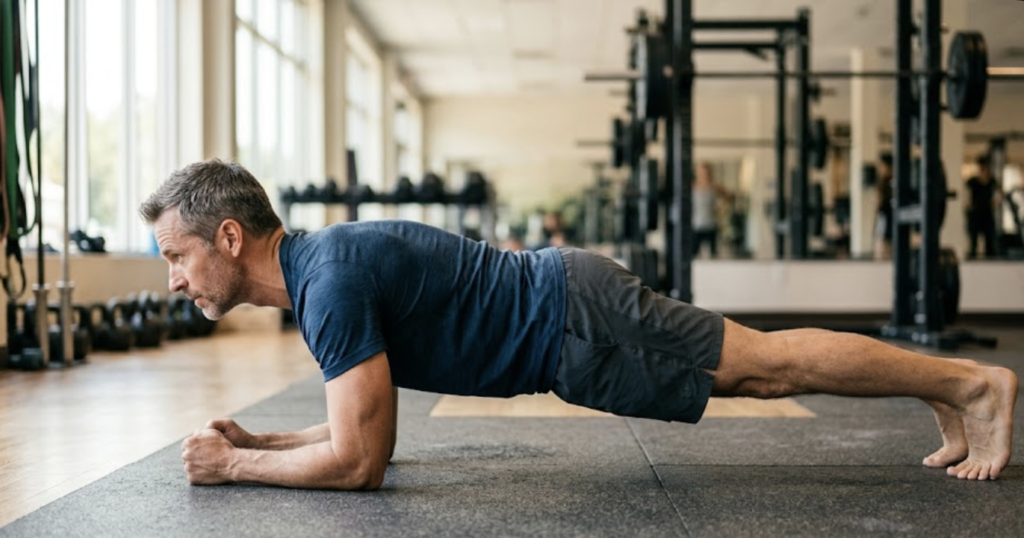
Harvard Medical School specifically recommends planks and bird dogs — not sit-ups — for core strengthening. The reasoning: the deep stabilising muscles respond to isometric holds and controlled movement, not high-repetition spinal flexion. Add pallof presses and dead bugs. Train these movements with the same seriousness you apply to your main lifts.
Consistency over intensity.
Harvard Health is explicit on this point: stretching once won’t give you flexibility. It may have taken months to develop tight muscles — you won’t reverse that in a few sessions. The improvements come from frequency. Ten minutes after every training session beats an hour once a fortnight. A daily practice delivers the greatest gains, but two to three times a week produces measurable, lasting improvement.

If you’re working on building strength alongside your flexibility work, the research on how muscle growth actually happens is worth reading before you add load.
The group class argument
If solo stretching isn’t happening — and for most people it isn’t, because it’s easy to skip and genuinely boring — consider a yoga or Pilates class once a week.
The accountability of a scheduled class, at a specific time, with other people present, removes the decision-making that kills solo mobility work. You’ve booked it. You’ve paid for it. You go. You do the work.
Book it the same way you book your gym sessions. Not as an afterthought. As a non-negotiable.
My Two Cents
You don’t need to become obsessed with flexibility or spend an hour stretching every day. What the evidence — including from Harvard Medical School — consistently supports is this:
Regular stretching of the major muscle groups, combined with genuine core stability work, done consistently over years, meaningfully reduces your injury risk and keeps you moving well into later life.
It’s not complicated. It’s just boring enough that most people don’t do it.
Do it anyway. Namaste!