The 30-Minute No-Equipment Workout You’ll Actually Do
This 30 minute no equipment workout is three rounds of seven exercises, done on whatever floor space you have. No gym, no kit, and no jumping required if the downstairs neighbours are a consideration. The full circuit is in the table below, and the form notes for each exercise are underneath it.
It works for beginners starting from scratch and for anyone who trains regularly but is travelling, or whose gym is shut. Thirty minutes, three times a week, is enough to move your baseline if you actually do it.
Before you start
Warm up for three to five minutes. Walk on the spot, swing your arms, do some slow hip circles and shoulder rolls. Do not skip this. Cold muscles do not perform well, and the warm up is the reason you will not feel destroyed the next morning.
Set a timer. Thirty minutes goes faster than you think.
The 30 minute no equipment workout
Three rounds of the circuit below. Each exercise runs for forty five seconds, with fifteen seconds to move to the next one. Rest sixty seconds between rounds.
| # | Exercise | Work | Works |
|---|---|---|---|
| 1 | Press-ups | 45 sec | Chest, shoulders, triceps, core |
| 2 | Squats | 45 sec | Quads, glutes, hamstrings |
| 3 | Plank | 45 sec | Deep core, shoulders |
| 4 | Reverse lunges | 45 sec | Glutes, quads, balance |
| 5 | Mountain climbers | 45 sec | Heart rate, core, shoulders |
| 6 | Glute bridges | 45 sec | Glutes, hamstrings, lower back |
| 7 | Superman holds | 45 sec | Lower back, posterior chain |
Fifteen seconds between exercises · Sixty seconds between rounds · Three rounds in total
How to do each exercise
Press-ups
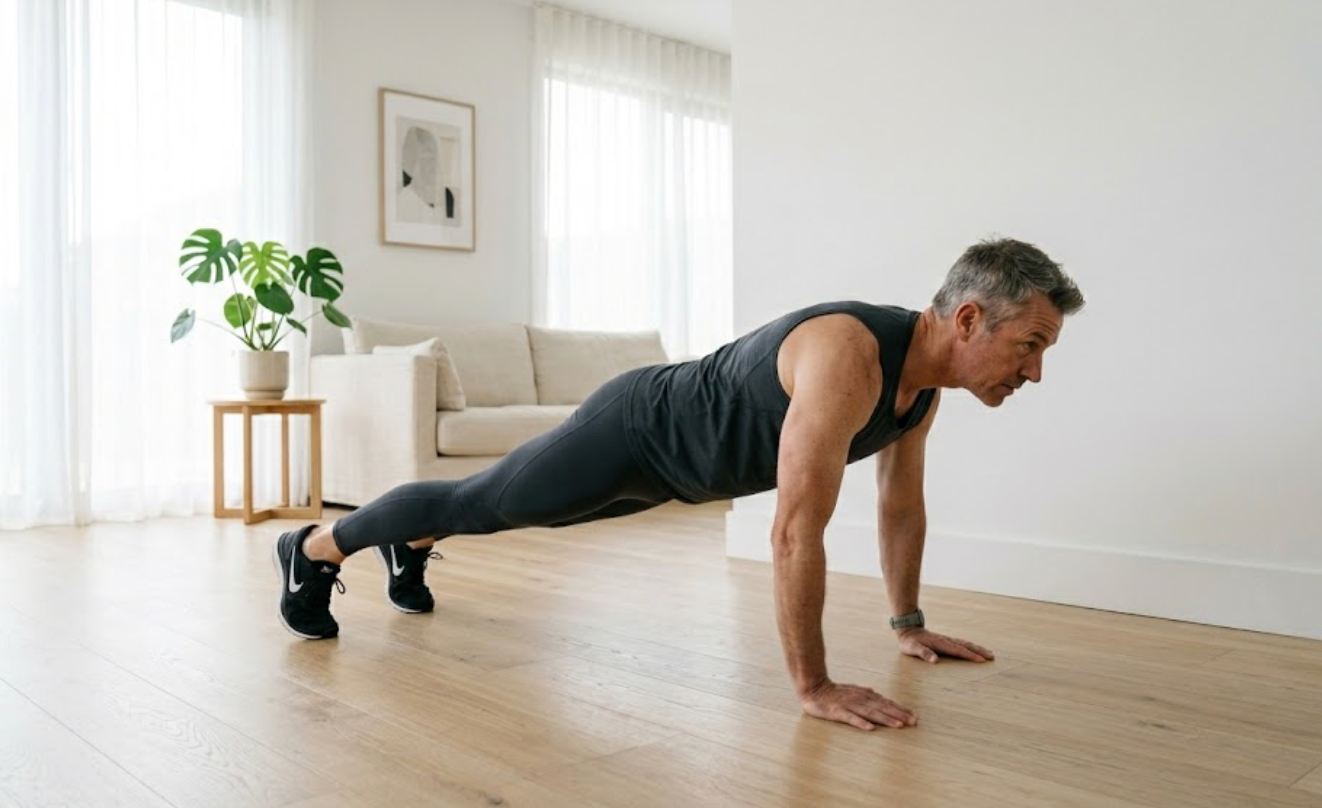
Hands shoulder width apart, body in a straight line from head to heels. Lower your chest to the floor, push back up. If full press-ups are not there yet, drop to your knees. This is not a competition. Keep your core tight and do not let your hips sag.
Do as many as you can with good form in forty five seconds, and stop before the form goes. Two bad press-ups are not worth five good ones.
Squats
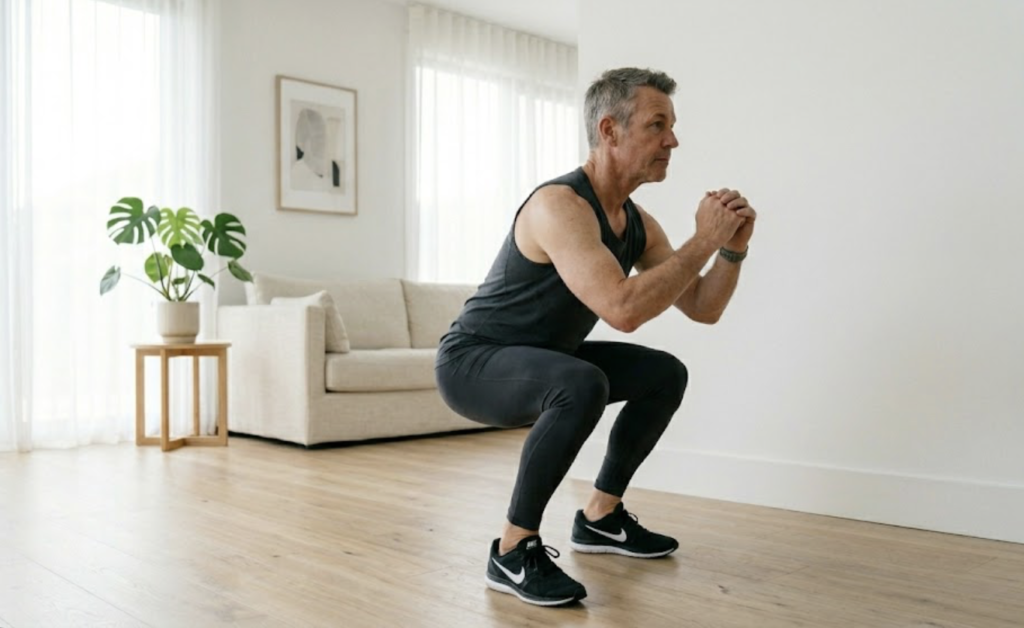
Feet shoulder width apart, toes turned slightly out. Sit back and down as if there is a chair behind you. Keep your chest up and your knees tracking over your toes. Drive through your heels to stand.
Bodyweight squats done properly work. The tendency is to rush them, so resist that. Slow and controlled beats fast and sloppy every time.
Plank

Forearms on the floor, elbows under shoulders, body straight. Hold. Breathe. Do not let your hips rise or drop. If forty five seconds is easy, move to a full press-up plank position. If it is too hard, drop to your knees and the core still works.
The plank is boring. It is also one of the most effective core exercises available, which is why it is in here. Harvard Medical School recommends it specifically for building the deep stabilising muscles that matter for long term back health and injury prevention.
Reverse lunges
Stand tall, step one foot back and lower your back knee toward the floor. The front knee stays above the ankle. Push back to standing and alternate legs. Reverse lunges are kinder to the knees than forward lunges and still hit the glutes and quads properly.
Mountain climbers
Press-up position, drive one knee toward your chest and then the other in a running motion. Keep your hips level and your core engaged. These are the cardiovascular element of the circuit and they will raise your heart rate quickly. Control the pace rather than going flat out and losing form.
Glute bridges
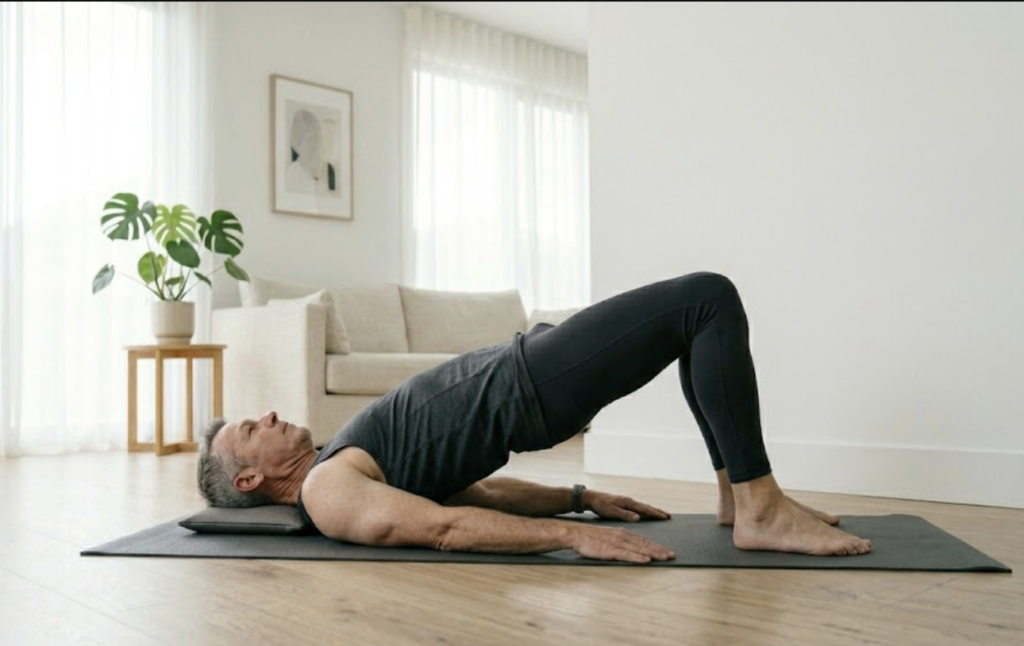
Lie on your back, knees bent, feet flat. Drive your hips up by squeezing your glutes, hold for a second at the top, lower slowly. These work the posterior chain, meaning glutes, hamstrings and lower back, which most people underwork badly relative to the front of the body.
If it feels too easy, progress to single leg glute bridges. One leg extended, drive through the other. Immediately harder.
Superman holds
Lie face down with your arms extended in front of you. Lift your arms, chest and legs off the floor at the same time. Hold for two to three seconds, lower, repeat. This works the whole posterior chain and the lower back stabilisers, which are the muscles most likely to go weak from prolonged sitting.
What the 30 minutes looks like
| Block | Time |
|---|---|
| Warm up | 3 to 5 minutes |
| Round 1 | 7 minutes |
| Rest | 1 minute |
| Round 2 | 7 minutes |
| Rest | 1 minute |
| Round 3 | 7 minutes |
| Cool down | 5 to 7 minutes |
| Total | About 30 minutes |
The cool down
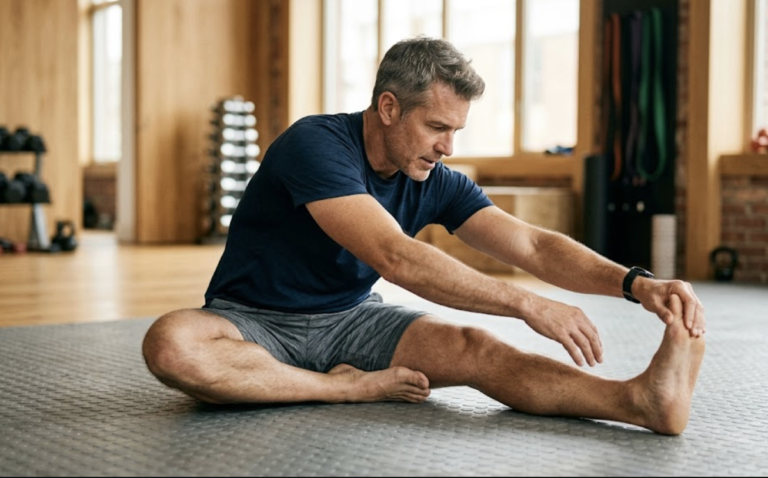
Five to seven minutes of stretching. Hip flexors, hamstrings, chest, shoulders, lower back. Hold each stretch for thirty to sixty seconds. Do not rush it, because the cool down is where you prevent tomorrow’s soreness. There is more on why this matters in the piece on stretching and core strength after 40.
Making it harder
When three rounds starts to feel manageable, change one variable at a time rather than all of them:
- Add a fourth round
- Cut the rest between rounds to forty five seconds
- Slow down the lowering phase of every exercise
- Progress press-ups from knees to full
- Progress squats to jump squats, if the knees allow it
- Progress the plank to a full press-up plank
When it feels easy again, change another one. The body adapts, so the workout has to move with it.
Making it easier
If you are starting from nothing, start here instead:
- Two rounds rather than three
- Ninety seconds rest between rounds
- Press-ups on your knees
- A smaller range of motion on the squats
- Plank on your knees
Build up from there. The goal in week one is finishing it, not finishing it perfectly. If you would rather follow a structured progression than improvise one, the 8 week beginner home workout plan lays it out week by week.
Is 30 minutes enough for a workout?
For general fitness, yes. Thirty minutes of circuit training done at a decent intensity covers strength, core and cardiovascular work in one session, and it clears the weekly activity thresholds most health bodies set if you do it three times a week.
What thirty minutes of bodyweight work will not do is match a dedicated strength programme for building maximum muscle, or match running and cycling for endurance. It is a strong baseline, not a specialist tool.
How many times a week should you do it?
Three times a week, with a rest day between sessions. Monday, Wednesday and Friday is the obvious shape. The rest days are not optional extras, because muscle is built during recovery rather than during the session.
Four sessions a week is fine once three feels routine. Every day is not better, and for most people it is how the whole thing quietly falls apart by week three.
Can you build muscle with no equipment?
You can, up to a point. Muscle growth is driven by mechanical tension and progressive overload, and bodyweight training can deliver both for as long as you keep making the movements harder. Beginners in particular gain a lot from bodyweight work alone.
The ceiling arrives when your bodyweight stops being a meaningful load. At that stage you need external resistance or harder variations. The mechanics behind all of that are covered in the guide to how to actually build muscle.
How many calories does a 30 minute bodyweight workout burn?
Somewhere in the region of 200 to 350 for most people, though the range is wide. Bodyweight and intensity drive it more than the exercise selection does, and a heavier person working at the same effort burns more than a lighter one.
Treat any single figure with suspicion, including that one. If you want a number anchored to your own body rather than an average, the TDEE calculator gives you a daily baseline to work from.
What this workout will and will not do
Thirty minutes three times a week produces real results if you are consistent and you keep making it harder. It will lift your baseline fitness, strengthen your core, and give you something you can do in a hotel room with no kit and no excuses.
It will not replace heavy strength training for building size, and it will not build the engine that running or spinning builds. For most people, at most points in their lives, that trade is fine.