
Halloween Is Irish. Here’s Everything Else.
Before the plastic skeletons and the fun-size Snickers and the group costume that requires thirty seconds of explanation, there was a night called Oíche Shamhna. Pronounced roughly ee-ha how-na. It means Samhain Eve. It started in Ireland. And the version of it you’re planning right now — wherever you are in the world — is a direct descendant of something that began on a hillside in ancient Celtic Ireland over two thousand years ago.
Where Halloween actually came from
The Celtic calendar divided the year in two: the light half and the dark half. Samhain — the word means roughly “Summer’s End” — was the hinge point. The night of October 31st was the last night of the old year and the first of winter. On the Celtic calendar, it was the equivalent of New Year’s Eve.
The Celts believed that on this particular night, the boundary between the world of the living and the world of the dead became thin enough to cross. Not just symbolically — literally. The dead could walk among the living. Other spirits too, less friendly ones, moved freely through the darkness. The Irish called them the Aos Sí, pronounced ees shee — spirits of the other world who could cause harm to anyone unlucky enough to cross them.
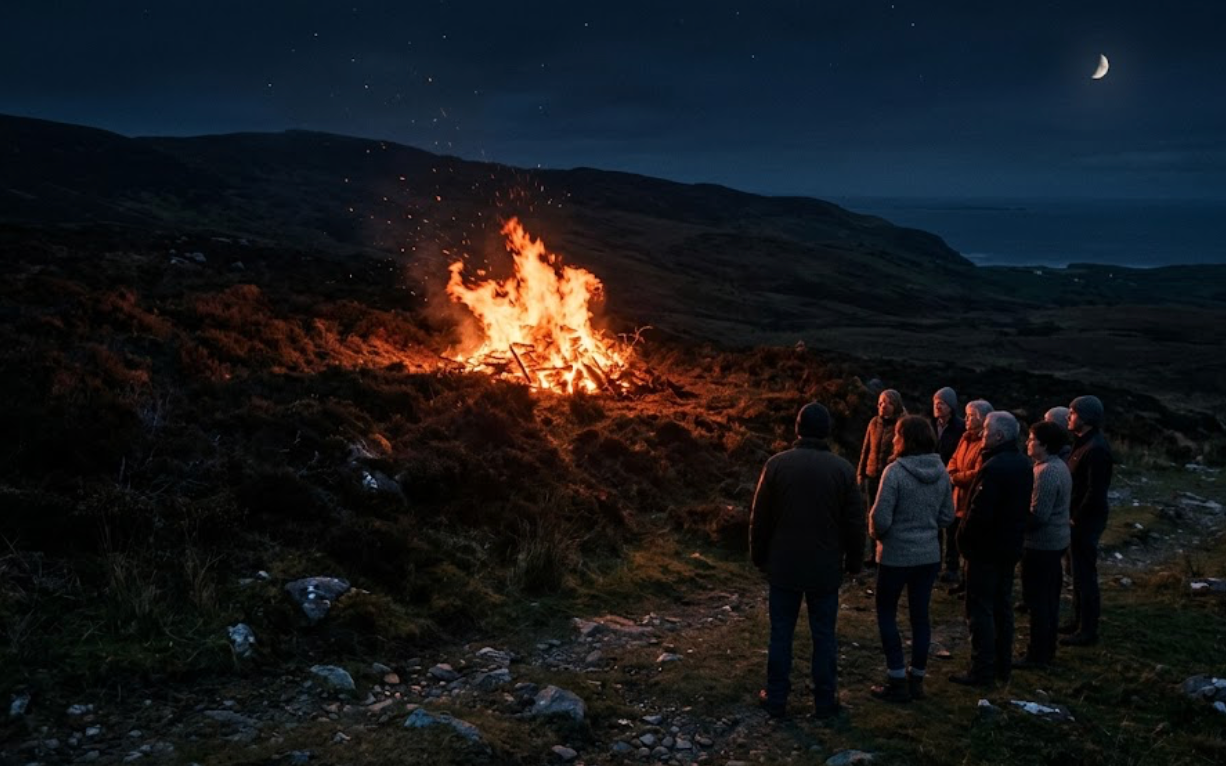
The response to this was practical rather than fearful. Families set a place at the table for ancestors who might return to visit. Food was left outside for wandering spirits, an offering to keep them peaceful. Bonfires were lit across the hillsides — enormous communal fires, the most sacred of which burned on the Hill of Tlachtga in County Meath. Before Oíche Shamhna, every household fire in Ireland was extinguished. When the festival fire was lit, families carried its flame home to relight their own hearths. It was a communal renewal. A whole country starting the new year from the same fire.
The costumes came from the same practical logic. If dangerous spirits were wandering, the safest approach was to look like one of them. People dressed in animal skins and wore masks to move through the night undetected. Disguise as protection.
Somewhere in that tradition is the origin of your child’s inflatable dinosaur costume and the bowl of Reese’s Pieces by your front door.
How it became Halloween
The Roman Empire absorbed Celtic territories and brought two autumn festivals with it: Feralia, a commemoration of the dead, and a festival honouring Pomona, the goddess of fruit and trees — which is almost certainly why apples became a Halloween thing.
Christianity arrived next. The Church designated November 1st as All Saints’ Day — All Hallows’ Day — and the night before became All Hallows’ Eve. Hallows’ Eve. Halloween. The name is medieval English grafted onto an Irish festival, which had already absorbed Roman traditions. By this point it’s a palimpsest of cultures, all written over the same original night.
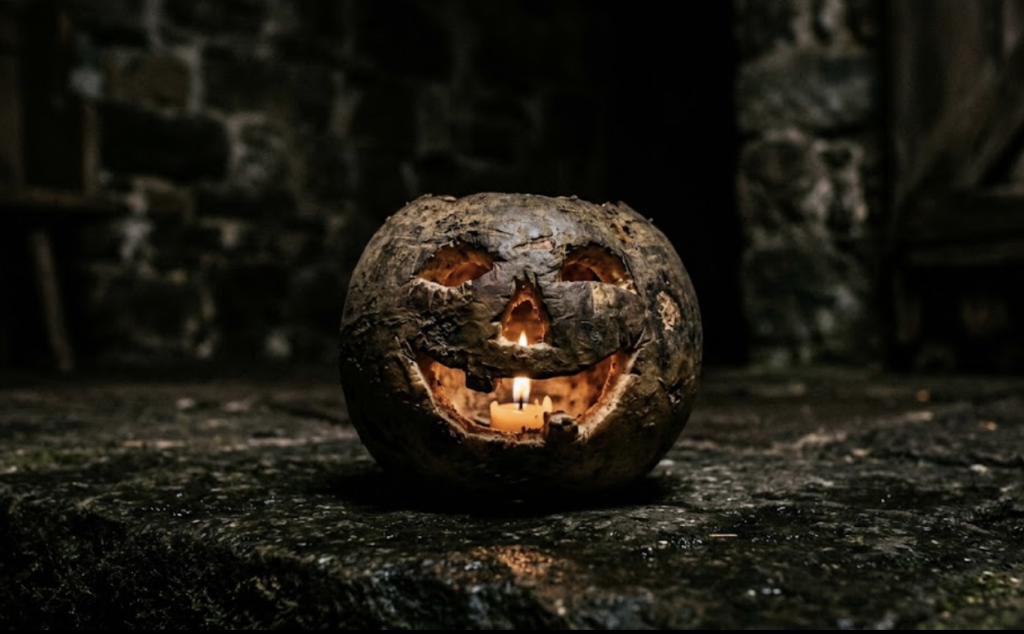
Irish and Scottish immigrants carried their Samhain traditions to America in the 18th and 19th centuries. The new world had pumpkins where Ireland had turnips — pumpkins are larger, easier to carve, more theatrical. The Jack-o’-lantern was originally a carved turnip. The practice of carving faces into vegetables to ward off spirits is documented in Ireland long before anyone thought to do it to a pumpkin.
By the mid-20th century, the American version of Halloween had become the dominant export: costumes, trick-or-treating, haunted houses, a specific aesthetic of orange and black that you now see in every supermarket from Sydney to Stockholm every October.
How Halloween is celebrated today — by market
Ireland
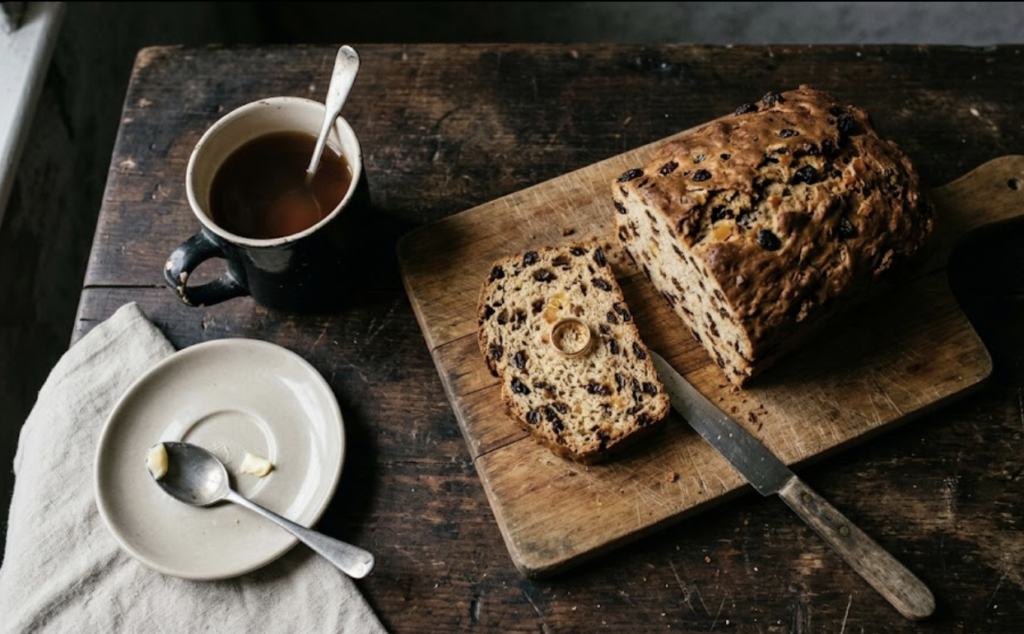
In Ireland, Halloween is still called Oíche Shamhna, and it’s taken seriously. Bonfires remain a tradition in many areas, particularly outside the cities. Fireworks — technically illegal but widely available — are a fixture. The Samhain festival in Derry is one of the largest Halloween celebrations in the world, drawing enormous crowds every year. Children still go guising — door to door in costume — though “trick or treat” has largely replaced the older phrase “help the Halloween party.” Barmbrack, a fruit bread with objects baked into it, is a traditional Irish Halloween food: find the ring and you’ll marry, find the coin and you’ll prosper, find the rag and the year ahead is uncertain.
United Kingdom
Halloween in the UK has grown considerably over the past two decades, driven largely by American cultural influence and supermarket seasonal ranges. It is not a public holiday. Trick-or-treating, pumpkin carving, and costume parties are all mainstream now, with UK spending on Halloween running into hundreds of millions of pounds annually. Bonfire Night on November 5th — Guy Fawkes — has historically been the bigger autumn event in England, and the two occasions sometimes blur together.
United States
The US version is the one that exported itself to the world. Trick-or-treating is a nationwide ritual for children. Haunted houses — elaborate walk-through horror experiences run as temporary commercial attractions — are an American invention with no equivalent elsewhere. Costume parties for adults are as mainstream as those for children. The spend is extraordinary: Americans spend several billion dollars on Halloween annually, covering costumes, decorations, candy, and seasonal events. More than 70% of US households participate in handing out candy.
Australia
Halloween in Australia has grown steadily, arriving via American cultural influence rather than any historical Celtic connection. It remains more suburban than national — some neighbourhoods go all-in while others ignore it entirely. The timing is slightly awkward: October 31st falls in Australian spring, so the autumn harvest imagery that underpins the whole aesthetic doesn’t map naturally onto the season. Despite this it continues to grow, particularly among families with young children.
The traditions worth knowing
Jack-o’-lanterns
Carved in Ireland from turnips for centuries before Irish immigrants arrived in America and found pumpkins. The legend attached to them is that of Stingy Jack, an Irish trickster who twice tricked the Devil and was barred from both heaven and hell upon his death, condemned to wander with only a carved turnip lantern to light his way.
Trick-or-treating
Descended from the practice of leaving food out for wandering spirits on Oíche Shamhna, and from the Christian tradition of “souling” — going house to house offering prayers for the dead in exchange for food. The modern American version, with children in costume collecting sweets from neighbours, solidified in the mid-20th century and spread globally from there.
Costumes
Originally functional. You wore a disguise on Samhain because the spirits couldn’t harm what they couldn’t identify. The animal skins of ancient Celtic Ireland became the elaborate costume industry of modern Halloween, which is now one of the largest seasonal retail categories in most English-speaking markets.
Bonfires
The oldest tradition and still the most Irish one. The communal bonfire at Samhain was a sacred act — the source from which all other fires in Ireland were relit. In the US and UK, bonfires have largely disappeared from Halloween (though they persist in the UK on November 5th). In Ireland, they remain.
Divination
Oíche Shamhna was historically considered a powerful night for predicting the future. The thinning of the veil between worlds made divination more potent. Apple-bobbing is a remnant of this — it originated as a divination practice involving apples and the Roman goddess Pomona, who was associated with fertility and the harvest. The barmbrack tradition in Ireland is another.

Halloween 2026 — practical notes
October 31st 2026 falls on a Saturday. That makes it one of the better Halloween dates in years — no school or work the next morning, parties can run as late as they need to, and the full weekend is available for anyone who wants to stretch the celebrations across two days.
In the US and UK, supermarkets and pop-up costume shops start stocking from early October. Leaving costume buying until the week before means picking from whatever’s left. For anything specific — particularly for children with a precise vision of what they want to be — earlier is better.
Trick-or-treating etiquette varies by neighbourhood. A pumpkin or lit porch light is the universal signal that a house is participating. In the absence of either, skip it. In the US, most trick-or-treating happens between 5:30pm and 9pm. In Ireland and the UK, earlier is more common, particularly for younger children.
The thing most people don’t know
Halloween went from Ireland to America, got substantially amplified, and then came back to Ireland and the UK in its American form. The country that invented the festival now celebrates a version of it that was exported, transformed, and reimported. The barmbrack and the bonfire and the guising are still there if you look for them. The inflatable skeleton on the front lawn is American.
Neither version is wrong. They’re just different layers of the same two-thousand-year-old night.


