Pizza Dough Calculator: Flour, Water and Hydration
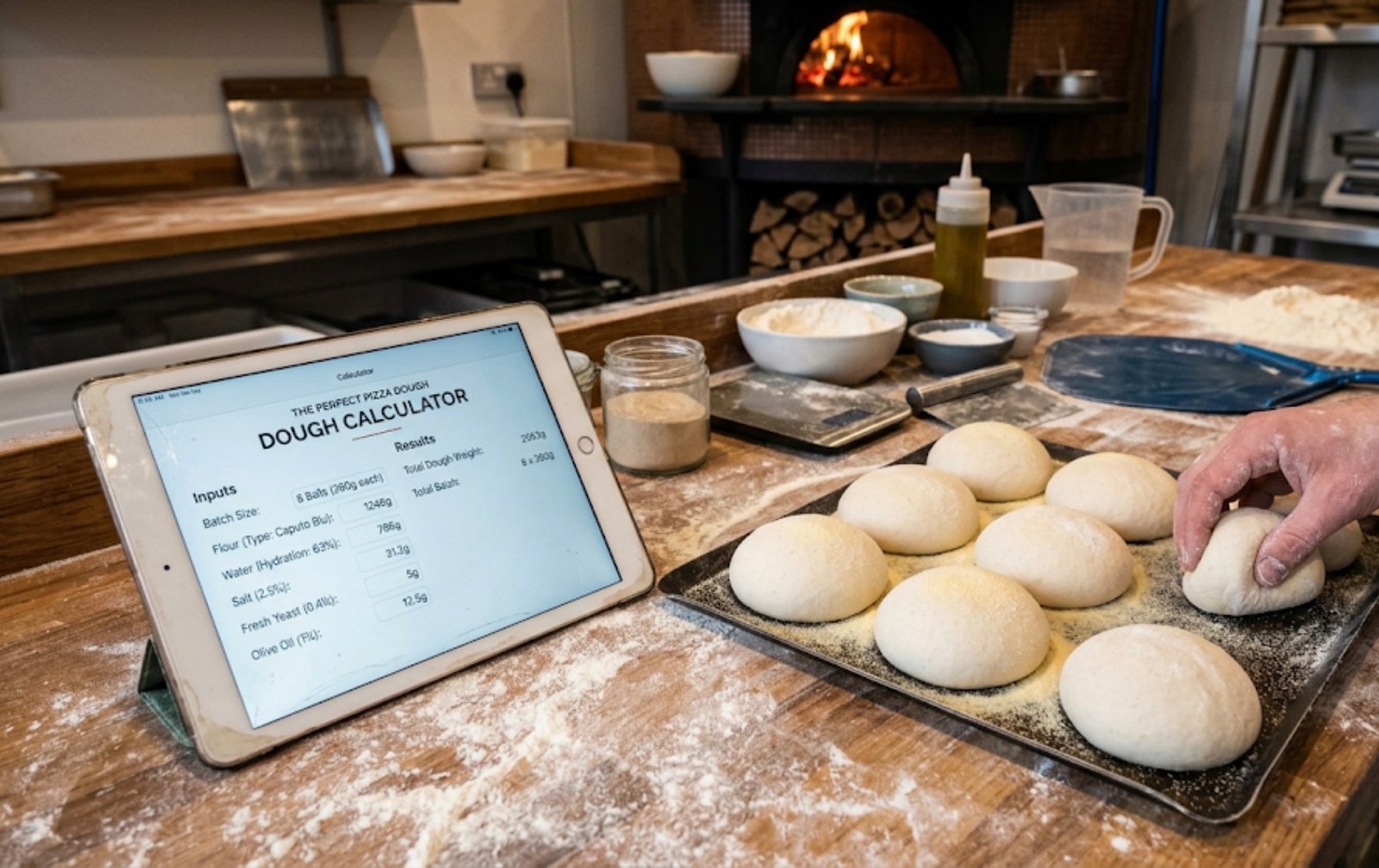
Work out exactly how much flour, water, salt and yeast you need for pizza dough, scaled to the number of bases you want and the hydration you are after. Set your ball count and weight, choose a hydration level, and the calculator does the baker’s percentage maths for you.
Advanced: salt, yeast and oil
How the pizza dough calculator works
The calculator runs on baker's percentages, the system every pizzaiolo and baker uses. Flour is always 100 percent, and every other ingredient is expressed as a percentage of the flour weight. Hydration of 62 percent means 62 grams of water for every 100 grams of flour. Salt at 2.8 percent means 2.8 grams per 100 grams of flour, and so on.
You give it the finished dough weight you want, the ball count multiplied by the weight per ball, and it works backwards to the flour figure that produces exactly that, then calculates the water, salt, yeast and oil from there. That is why the totals always add up to the dough weight you asked for, with nothing left over and nothing short.
How much does a pizza dough ball weigh?
It depends on the style. A Neapolitan base is usually 250 to 280 grams, which gives a roughly 12 inch pizza with a puffed edge. New York style runs a little heavier at 280 to 320 grams for a wider, foldable slice. Pan and Detroit styles go heavier still, since the dough fills a tray rather than being stretched thin. The three preset buttons cover the common starting points, and you can type any weight over them.
What hydration should pizza dough be?
For most people, most of the time, 60 to 65 percent is the sweet spot. It handles well, shapes without fighting you, and bakes into a proper crust in a home oven. Go higher, toward 70 percent and beyond, for a lighter and more open crumb, but a wetter dough is stickier to work and really wants the fierce heat of a dedicated pizza oven to shine. Go lower, under 58 percent, for a firmer dough and a crisper, thinner base.
The heat you are baking with matters as much as the number. A wet, high hydration dough that sings at 450 degrees in a pizza oven can bake pale and heavy in a domestic oven that tops out far lower. If you are weighing up whether a dedicated oven is worth it, the guide to whether outdoor pizza ovens earn their place covers what the extra heat actually gets you.
How much yeast goes in pizza dough?
Less than you think, and it depends on time. The 0.3 percent default suits a same day dough proved at room temperature over several hours. For a long cold ferment in the fridge over one to three days, which builds far more flavour, drop the yeast lower, toward 0.1 percent, so the dough does not over prove before you bake it. More yeast is not better. Time does the work that flavour needs, and a slow rise beats a fast one every time.
Can you scale this for any number of pizzas?
That is the whole point of it. Set the ball count to whatever you are feeding, from one base to sixty for a party, and the quantities scale exactly while the ratios hold. The dough behaves the same whether you are making two or twenty, so you can dial in a recipe you like on a small batch and then reproduce it at any size with confidence.